Gabon
- Karen Darnell

- Jan 22, 2021
- 5 min read
Every week John gathers a group of physicians, researchers, scientists, ethicists, pastors, professors, and others with similar interests. I’m flattered they include me. We normally meet in his home, but we’ve been on Zoom for ten months now. We take turns setting the topic for discussion. John recently asked me to bring one of my blogs and lead the conversation. Gabon presents some lively subjects, but how do I choose? Here are some of the options:
Topic #1: “Africa’s belly will soon be as sterile as mine” Feminism and Africanism
My daughter Kristen gave me Angèle Rawiri’s book The Fury and Cries of Women for Christmas. Angèle Ntyugwetondo Rawiri was the first Gabonese novelist and when I googled writers from Gabon, the top five are women.
The setting of the novel is a government job and a beautifully decorated home, with custom woodworking, custom drapes, and a wife dealing with multiple miscarriages and the infidelity of her husband. This could be a novel in any developed country with social class issues, prejudice between the various ethnic groups, and mother-in-law problems. The local color is that traditions and customs that might have worked in the villages are not working in the multicultural city. The political ideas for a healthier Africa and changing visions of family structure would be a great topic for a lecture by a qualified instructor. Because we all have sympathy, but none of us have experience with Africanism, I think the next subject would draw more discussion from my weekly group.
Topic #2: Treating “Primitives” The Attitudes of Albert Schweitzer
When Allan was in medical school, we heard an NPR interview in which the statement was made that doctors tell patients what to do and lawyers ask their clients what they want to accomplish. The point made was to stop being paternalistic and ask what your patient wants. I remembered this while reading On the Edge of the Primeval Forest: Experiences and Observations of a Doctor in Equatorial Africa by Albert Schweitzer (available here http://www.gutenberg.org/ebooks/50015) and watching The Great White of Lambaréné, a film by Bassek ba Kobhio (available on Kanopy).
I can’t read Schweitzer’s book without recognizing how many people he helped physically. I can’t watch Ba Kobhio’s movie without understanding that Schweitzer lost an opportunity to respect and be in mature relationships with those he encountered. To put it briefly, the African people disliked being called primitive and resented that although Schweitzer knew many languages, he never learned theirs.
This brings up so many questions that could start a great discussion:
1. What were your experiences as a medical missionary? (Some of the physicians in the group have worked internationally, so they will have stories to tell.)
2. How have ideas about international medical work changed over the course of your career?
3. In what ways do you sympathize with Schweitzer, who spent so much of his life bringing medical care to the people of Gabon?
4. In what ways do you sympathize with the people of Gabon, who needed the medical care, but would have preferred to be treated as adults.
5. To what extent do we require Albert Schweitzer (or any medical professional, or any European, or anyone) to be good at relationships in order to value what they do?
Topic #3: “Can you make a non-racist Tarzan movie?” What to Do with Racist Literature
Gabon claims the Tarzan story. The child Lord William Charles Midlin was shipwrecked there in 1868 and survived fifteen years in the jungle with the support of a group of apes. Nobody is going to argue however that Edgar Rice Burroughs wrote books that were racially equitable and stayed true to the original story. Nor will we argue that the 120 Tarzan movies depicted African people appropriately. The Disney version didn’t depict Africans at all!
Attempting to make a non-racist Tarzan movie, The Legend of Tarzan adds elements of another true story, that of George Washington Williams. He wrote an open letter to King Leopold of Belgium revealing the atrocities enacted in the Congo, one of Gabon’s neighbors to the south. The Legend of Tarzan also goes back to Gabon, and I would watch this movie for the amazing scenery alone. I picked up The Legend of Tarzan at the San Bernardino County Library and it can be rented for $3.99 on Amazon.
This subject would be appropriate for my racial equity group with the Redlands branch of the American Association of University Women. They would be happy to discuss:
1. What literature do we love that we are uncomfortable passing along to our children?
2. Can any of this literature be reclaimed? If so, how? If not, what do we do with it?
Topic #4: “Mad-Hatter’s Tea Party of Survivor” Is Survivor Gabon Good or Awful?
My dad, sister, and I are huge Survivor fans. I watched Survivor Gabon when it first came out. It is chaotic and dysfunctional. Some players have little sense of reality, and really, would you have chosen teams the way they did? But knowing the outcome of the game, was that crazy like a fox? But I can’t tell you much more without spoilers and it is available right now on Amazon Prime. Watch it and tell me, is this the best Survivor ever or the worst? Why?
Topic #5: “Surfing Hippos” Conservation in Gabon
A discussion of conservation could be started by watching the National Geographic conference Protecting Gabon: The Expedition that Changed Conservation. The main event is an interview with Mike Fay and Nick Nichols, the leader and photographer for a team walking more than 3,000 miles starting northeast of Gabon and ending at the coast, documenting Africa’s largest stretch of continuous rainforest. If you want to skip the introductions, go to the 22 minute point: https://www.youtube.com/watch?v=lLX0mNeKpR8 For more of Nick Nichols photography, see here: http://100photos.time.com/photos/michael-nichols-surfing-hippos
Okay, enough with the discussion topics. It’s time for music, art, food, a graphic novel (yes, they have them in Africa too!), and a woman who wore her Victorian street clothes to explore the jungle (the things we have done to maintain our decorum!).
· Musicians from Gabon include
Annie-Flore Batchiellilys: https://www.youtube.com/watch?v=JIgJNCMom_E
Patience Dabany: https://www.youtube.com/watch?v=XsDMPc2qAV0
Oliver N'Goma: https://www.youtube.com/watch?v=AIakENAFMJw
Pierre Akendengue: https://www.youtube.com/watch?v=d9xmMK-uWLA
· An important piece of art is explained by the Khan Academy: https://www.khanacademy.org/humanities/art-africa/central-africa/gabon-art/v/kota-reliquary
· A variety of Gabonese recipes can be found here: http://www.healthy-life.narod.ru/wor_ek77.htm
· Words Without Borders has part of a translated graphic novel: https://www.wordswithoutborders.org/graphic-lit/from-life-of-pah
· Mary Henrietta Kingsley, a Victorian woman explorer of Gabon, wrote a book found here: http://www.gutenberg.org/ebooks/5891
TheCrazy Tourist lists interesting things to do in Gabon: https://www.thecrazytourist.com/15-best-places-visit-gabon/#more-14964 and if you are planning a trip, a prominent example of their ecotourism is the lodge at Loango: https://www.loango-tourism.com/. Be sure and check in with your local travel advisor because getting around Gabon is complicated. Shout out to my favorite travel advisor, Kaitlin Darnell at Laura's Travel in Redlands. May the travel industry survive and thrive. May we all survive, thrive, recognize our mutual humanity, learn to deal with our conflicts, and allow peace and health to flourish in Gabon and throughout the world.
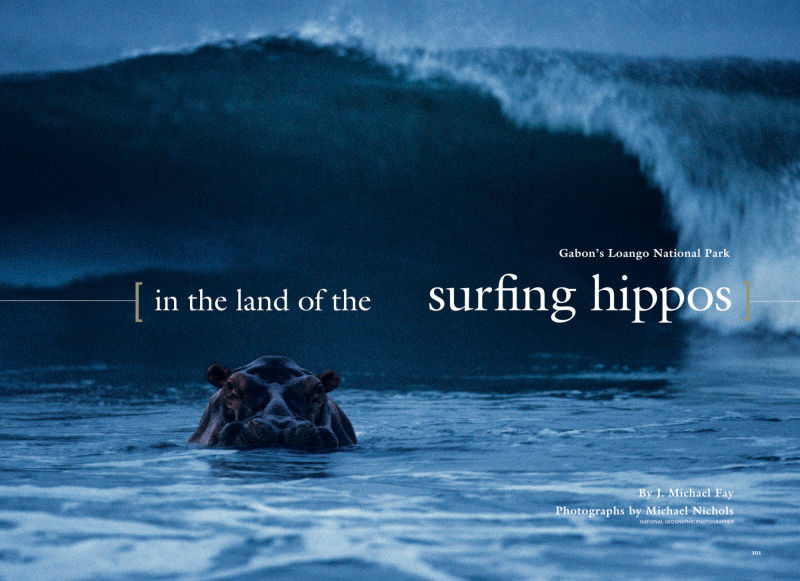
Photo credit: Michael (Nick) Nichols https://michaelnicknichols.com/in-the-land-of-the-surfing-hippos/
Sources of quotes: Rawiri’s book, Schweitzer’s book, Los Angeles Times headline, insidesurviver.com, National Geographic


Comments